Angle
Guess the angle size in degrees.
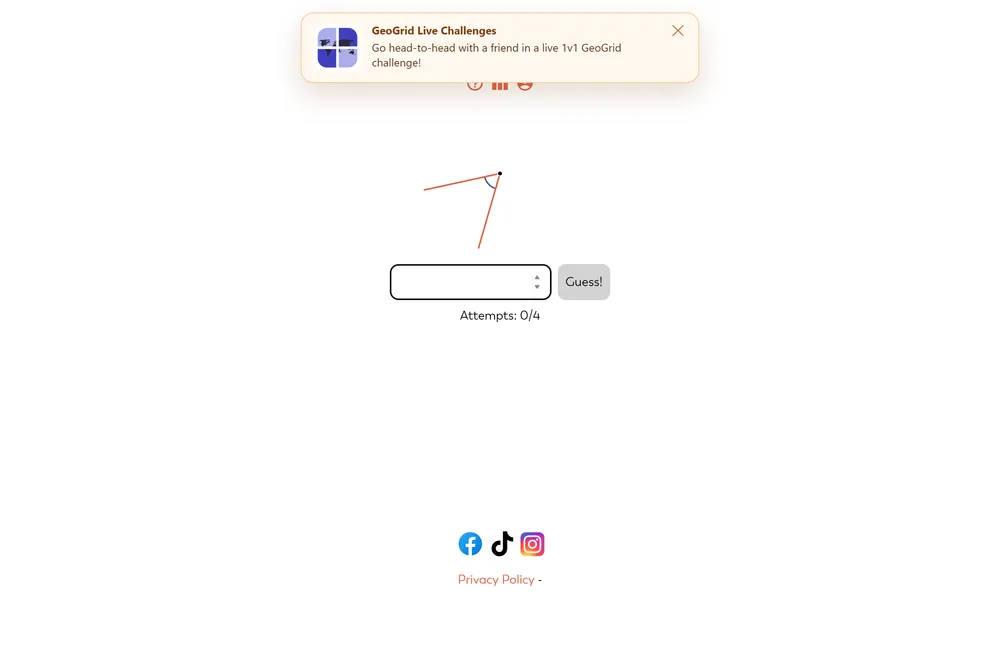
Angle is a daily geometry puzzle that shows you one angle drawn from a point and asks you to name its size in whole degrees. You have four guesses, and after each one the game tells you both which direction the true value lies and how close you are getting. It is a fast, original test of how well your eye reads degrees, and because the drawn angle can sometimes be reflex, you need an eye that stretches well past 180.
What is Angle?
Angle is a daily math puzzle built around a single skill: judging the size of an angle by eye. Each day the game draws one angle from a central point and asks how many degrees it spans. The answer is always a whole number, and you commit to a value by typing it in. Crucially, the target is not limited to the 0 to 180 range you might expect. Players have reported reflex angles well above 180 degrees, so a daily answer can run up toward 359, which makes the eye-calibration challenge wider than it first appears.
What separates Angle from letter and word puzzles is the layered feedback after each guess. The game does not just tell you the direction of the true value with a higher or lower arrow. It also returns a proximity reading, a temperature scale that runs through cues like getting hot, hot, and boiling, where boiling signals you are genuinely close. That second channel of information is the heart of Angle's strategy. A bare higher or lower hint only halves the range, but the temperature tells you whether you are circling the answer or still far off, so a single guess can carry two useful signals at once.
You get four guesses to land the exact degree. When you finish, Angle produces a spoiler-free result you can copy and share, using a Wordle-style emoji grid that summarizes how each attempt went rather than revealing the angle itself. That format lets you compare how efficiently you and a friend zeroed in on the same daily angle without spoiling the answer for anyone who has not played yet. Because every player worldwide sees the identical angle on a given day, those shared grids are directly comparable.
The vibe is quick and low pressure: most rounds take under a minute, and there is real satisfaction in calibrating your eye over time so that benchmarks like 30, 90, 150, and even 270 degrees start to feel obvious at a glance. It rewards spatial intuition more than arithmetic, which makes it friendly to people who do not consider themselves math fans, while still giving geometry students and teachers a genuinely useful daily warmup. One fresh angle per day keeps it a small ritual rather than a time sink.
How to play Angle
- Open angle.wtf and study the single angle drawn from the center point on screen, noting whether it looks narrower than a right angle, wider than a straight line, or somewhere in between.
- Estimate its size and type a whole number of degrees as your first guess, remembering the answer can be anywhere from a sliver up to nearly 360.
- Read the two hints Angle returns: a higher or lower arrow for direction, and a temperature cue for how close you are.
- Use both signals together to pick your next number, narrowing toward the range the arrow and temperature point to.
- Keep refining your guesses, watching the temperature climb toward boiling as you close in.
- Lock in the exact degree within your four total guesses, then copy the emoji result to compare with others.
Tips and strategy
- Calibrate against anchors first: fix where 90 degrees (a square corner), 180 degrees (a straight line), and 270 degrees (a three-quarter turn) would sit, then judge whether the drawn angle is wider or narrower than the nearest one.
- Watch for reflex angles. If the opening looks like it has swept past a straight line, the answer is above 180, so do not cap your guesses at 180.
- Open near a benchmark like 90 or 180 rather than a random number, so the first arrow cleanly splits the range into a half you can reason about.
- Treat the direction hint like a binary search and cut the remaining span roughly in half each time, but let the temperature override how big that cut should be.
- Watch the temperature as your primary signal once you are within range: if a guess reads boiling, move only a few degrees rather than making a large jump.
- Remember the answer is always a whole number, so when two adjacent integers both feel plausible, spend a guess on one to learn the exact direction to the other.
- If a guess cools off after a closer one, you overshot: step back toward the warmer guess instead of continuing in the same direction.
Good to know
- Category
- Math / geometry puzzle
- Resets
- New angle every day
- Guesses
- 4 attempts
- Answer
- Always a whole number of degrees, including reflex angles above 180
- Feedback
- Higher/lower arrow plus a temperature proximity hint (up to boiling)
- Cost
- Free to play in the browser
Angle FAQ
How many guesses do you get in Angle?
You get four guesses each day to name the exact size of the angle in whole degrees. After each guess you receive a direction arrow and a temperature hint to help you spend the remaining attempts wisely.
Can the angle be more than 180 degrees?
Yes. Angle can show reflex angles that sweep past a straight line, so a daily answer can run well above 180 and up toward 359 degrees. Do not assume the target is limited to the 0 to 180 range, and keep benchmarks like 270 degrees in mind.
Is Angle free?
Yes. Angle plays for free in any web browser at angle.wtf, with no download or account required.
When does Angle reset?
Angle is a once-a-day puzzle: a new angle appears each day, and everyone playing that day sees the same angle, so your shared result is directly comparable to other players'.
How is Angle different from Wordle?
Angle borrows Wordle's one-puzzle-a-day, limited-guess, shareable-result format, but instead of letters you estimate the degrees of a drawn angle. Its feedback also adds a temperature cue showing how close you are, not just a higher or lower direction.
What do the hints in Angle mean?
After each guess Angle shows whether the true angle is higher or lower than your number, plus a temperature reading of how near you are. Warmer cues up to boiling mean your last guess was close, so you can fine-tune by only a few degrees.