Boggdle
Find as many words as you can, Boggle-style.
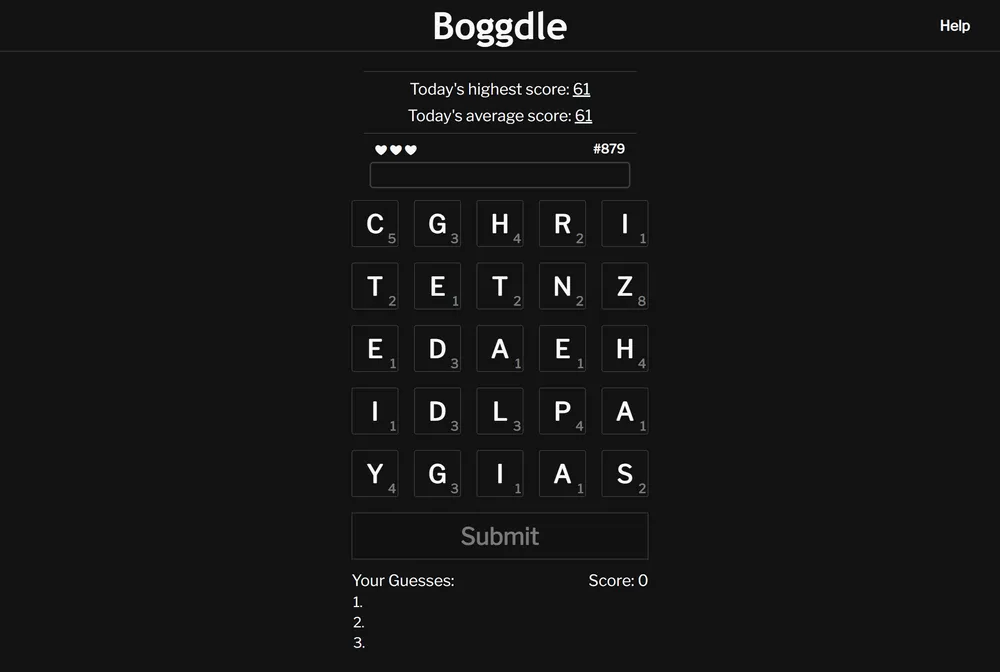
Boggdle is a word game that drops you into a Boggle-style letter grid and challenges you to find the best three words you can. Rather than racing to list every word on the board, you focus on tracking down a small handful of strong finds. It is a quick, browser-based puzzle for people who enjoy word searches, anagrams, and Scrabble-style hunting, built by an independent developer rather than tied to any official brand.
What is Boggdle?
Boggdle is a word-finding game built around a Boggle-style letter grid. As in the classic dice game it borrows its name from, you make words by stringing together neighboring tiles, moving from one letter to an adjacent one and using each tile at most once per word. The twist that gives the game its identity is its goal: instead of trying to list every word you can possibly spot, you are asked to find your best three words in the grid. That narrow target is the heart of the puzzle, turning a sprawling word hunt into a tighter search for a small set of standout finds.
That focus on just three words changes how the game feels compared with a full Boggle round. A traditional game of Boggle rewards a flurry of short, easy words piling up against the clock. Boggdle's three-word framing instead invites you to slow down, read the board carefully, and be selective about what you keep. Because the puzzle asks for a small, curated answer rather than an exhaustive list, a single session tends to be short and self-contained, which makes it easy to fit into a coffee break. Exactly how words are scored and ranked is not something the game spells out publicly, so the most reliable way to understand its scoring is to play a board and watch how your finds are valued.
Boggdle is the work of Simen Herland, a full-stack engineer who publishes it on his personal site at simenmh.com. It belongs to the broad family of lightweight browser word puzzles inspired by Wordle, where a fresh challenge is the appeal and the gameplay is simple enough to pick up in seconds. It is collected alongside other daily-style web games, which suggests it is meant to be revisited regularly, though the exact refresh cadence is best confirmed by visiting the page. Boggdle is not affiliated with the official Boggle brand from Hasbro; it is an independent, web-based take on the same word-on-a-grid idea.
The appeal is straightforward for anyone who likes anagrams, word searches, or Scrabble-style hunting. Because it runs in a browser as a small personal project, it is designed to be approachable with no heavy setup, and the three-word structure keeps each round quick rather than exhausting. It rewards a good eye for prefixes, suffixes, and the kinds of links between tiles that casual players tend to overlook, and it scratches the same itch as other browser puzzles: a small, repeatable challenge you can sit down with for a few minutes. If you want something wordier than a five-letter guessing game but lighter than a full Boggle marathon, Boggdle sits comfortably in between.
How to play Boggdle
- Open Boggdle in your browser at simenmh.com to load the letter grid.
- Form a word by connecting letters that touch each other on the grid, tracing a continuous path from tile to tile.
- Use each tile only once within a single word, just as you would in classic Boggle.
- Aim to find your three best words rather than trying to capture every word hidden in the grid.
- Look for longer or more unusual words, since a small set of strong finds is the goal of the puzzle.
- Revisit the page for a new grid when you want another round.
Tips and strategy
- You are only keeping three words, so favor quality over quantity: hunt for words you would be proud to turn in rather than easy fillers.
- Trace the full neighborhood of each tile before settling, since the links between adjacent letters are where the better words tend to hide.
- Anchor on flexible, common letters and look for words that wind through several tiles rather than sitting in one corner of the grid.
- Try stretching a base word with prefixes and suffixes like re-, un-, -ing, -er, or -ed when the connecting tiles allow it.
- Scan for more than three candidate words first, then keep only the strongest, holding your weaker finds in reserve.
- Watch for tiles that can do double duty, such as an S that pluralizes a word you already see, to extend a find cheaply.
Good to know
- Type
- Word game on a Boggle-style letter grid
- Core goal
- Find your best 3 words in the grid
- Format
- Quick single-session browser puzzle
- Cost
- Plays in a web browser at simenmh.com
- Creator
- Simen Herland, full-stack engineer (simenmh.com)
- Affiliation
- Independent; not an official Hasbro Boggle product
Boggdle FAQ
How does Boggdle work?
You get a Boggle-style grid of letters and build words by connecting neighboring tiles into a continuous path, using each tile once per word. Rather than listing every word you can find, the goal is to track down your best three words in the grid.
How is Boggdle scored?
The game does not publicly spell out its exact scoring or ranking rules, and no outside source confirms them. The clearest description of the goal is simply to find the best three words you can, so the most reliable way to learn how finds are valued is to play a board and see.
Is Boggdle the same as Boggle?
It is inspired by Boggle's grid-based word hunting, but it is an independent game with its own three-word goal rather than the classic find-everything-against-the-clock format. It is not an official Hasbro Boggle product.
Is Boggdle related to Wordle?
Not directly. Boggdle is an independent puzzle in the broad family of lightweight browser word games that Wordle helped popularize, but its gameplay comes from Boggle-style word hunting on a grid rather than guessing a hidden five-letter word.
Who made Boggdle?
Boggdle was made by Simen Herland, a full-stack engineer who hosts it on his personal site at simenmh.com. It is an independent project and is not affiliated with Hasbro's Boggle.