Crayondle
Guess the crayon color of the day.
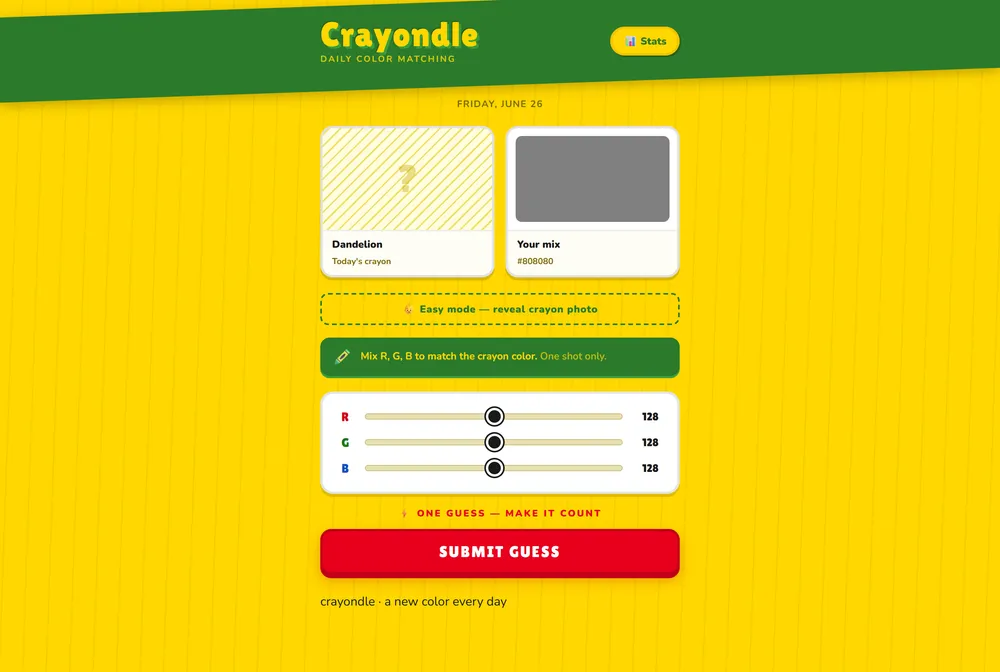
Crayondle is a daily color puzzle with one rule that changes everything: you get a single guess. Each day presents one target crayon color, and your job is to recreate it by mixing red, green, and blue with three sliders. Submit once, then see exactly how far off each channel was and what percentage you scored.
What is Crayondle?
Crayondle is a daily color game built around a single, deliberate idea: each day there is one target crayon color, and you get exactly one attempt to recreate it. Instead of typing letters into a grid, you work three sliders for red, green, and blue, each running from 0 to 255, and try to land on the same mix the game has chosen. The prompt on the page sums up the whole challenge plainly: mix R, G, B to match the crayon color, one shot only. There is no second round to walk back a bad slider, so the daily puzzle becomes a small exercise in reading a color and trusting your judgment.
What sets Crayondle apart from the wider field of Wordle-style games is that it is not a word or trivia puzzle at all. There are no hidden letters, no five-box rows, and no list of past attempts narrowing toward an answer. The entire game is perceptual: you look at a color, estimate how much red, green, and blue it contains, and commit. That single-guess design is unusually strict. Most daily games hand you several tries and a feedback loop; Crayondle gives you one slider set and one submit button, which makes the moment of pressing submit feel weightier than in a typical six-guess format.
The feedback is where Crayondle becomes genuinely instructive. After you submit, the game shows the target color beside your guess, then breaks the result down channel by channel, telling you how far off your red was, how far off your green was, and how far off your blue was. It also gives you a percentage score for how close your overall mix came, and it records that result into personal stats: games played, average percentage, current streak, and best percentage, with a distribution histogram showing where your scores tend to fall. A copy-result button lets you copy and share your outcome, and an easy mode reveals a crayon photo if you want a visual reference before committing.
The vibe is calm and self-contained rather than competitive. A round takes under a minute, the color resets to a new one each day, and the appeal is in slowly training your eye to translate a shade into numbers. Difficulty swings with the color: a clean primary or a near-black is forgiving, while muted pastels and earthy mid-tones can be brutal because a small error in two channels at once tanks the percentage. It suits people who like color, design, and art, anyone curious about how RGB values actually map to what they see, and players who enjoy a quick, low-stakes daily habit that rewards observation over vocabulary.
How to play Crayondle
- Open crayondle.com to load the day's single target crayon color.
- Read the swatch and estimate roughly how much red, green, and blue it contains before touching the sliders.
- Drag the R, G, and B sliders (each 0 to 255) to build a mix you think matches the target.
- Optionally turn on easy mode to reveal a crayon photo as a visual reference.
- Submit your single guess; remember there is no second attempt.
- Review the side-by-side colors, the per-channel miss for red, green, and blue, and your percentage score, then use copy result to share.
Tips and strategy
- Decide the dominant channel first: ask whether the color leans warm (more red) or cool (more blue), then set that slider before fine-tuning the others.
- Judge lightness early. Very light colors need all three channels pushed high together, while dark colors need all three pulled low, so set a baseline before chasing the hue.
- Watch for grays and browns, where red, green, and blue sit close together; small gaps between the three channels create the subtle tint, so nudge in tiny steps.
- Pay close attention to green, since it has a strong effect on how bright a color reads; if your guess looks too vivid or too washed out, the green channel is often worth a second look.
- Use easy mode's crayon photo when the swatch is ambiguous, since a second view of the color can help you decide whether it is more saturated or more muted than it first appears.
- Because you only get one shot, commit to a confident estimate rather than second-guessing; learn from the per-channel miss numbers afterward to calibrate the next day.
Good to know
- Resets
- Daily, one new crayon color per day
- Cost
- Free to play in the browser
- Attempts
- One guess per day
- Input
- R, G, B sliders, each 0 to 255
- Feedback
- Per-channel miss plus an overall percentage score
- Stats
- Games played, average percent, current streak, best percent, score distribution
Crayondle FAQ
Is Crayondle free?
Yes. Crayondle plays for free in a web browser at crayondle.com with no purchase or account required.
How many guesses do you get in Crayondle?
Just one. Crayondle is a single-shot game: you set the R, G, and B sliders and submit one guess for the day's color, with no second attempt.
How does the scoring work in Crayondle?
After you submit, Crayondle shows your color next to the target, reports how far off your red, green, and blue each were, and gives an overall percentage for how close your mix came.
Is Crayondle related to Wordle?
Only in format. It is a daily one-color-per-day puzzle inspired by the Wordle habit, but it uses RGB color matching instead of letters, so there are no words involved.
What is easy mode in Crayondle?
Easy mode reveals a photo of the crayon as a visual reference before you commit your guess, which can help when the target swatch alone is hard to read.