Spelling Bee
Make as many words as you can from seven letters.
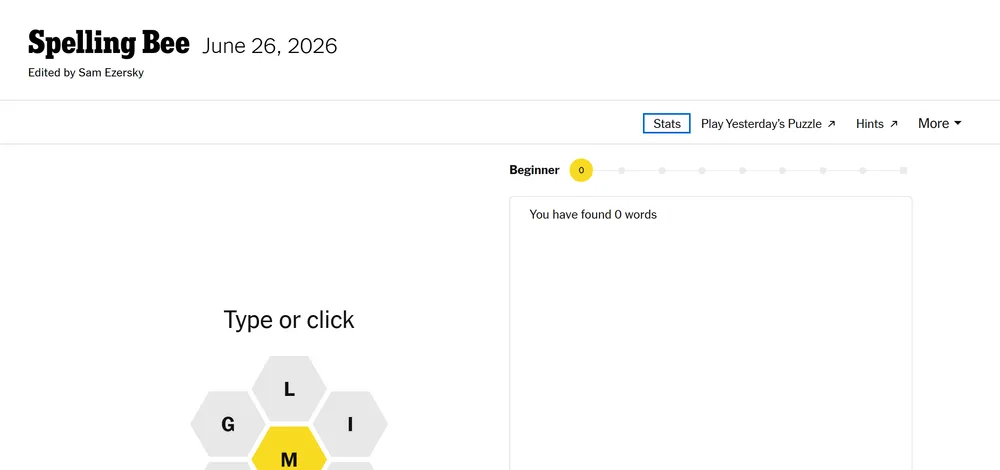
Spelling Bee is The New York Times' honeycomb word game, where seven letters and one mandatory center letter become the raw material for as many words as you can find. Every answer must be at least four letters long and must use that center letter, and you score points to climb from Beginner toward the prized Genius rank. One fresh letter set is published each day.
What is Spelling Bee?
Spelling Bee is a daily word game from The New York Times built around a honeycomb of seven letters: six on the outside and one required letter fixed in the center. Your job is to build as many valid words as you can from those letters before the next puzzle replaces them. A word counts only if it is at least four letters long and includes that center letter, and any letter in the set can be repeated as many times as a word needs. Because the seven letters stay the same all day, the puzzle is less about a single lucky guess and more about how thoroughly you can mine one small alphabet.
What sets it apart from Wordle and most other daily word games is that there is no hidden answer to deduce and no limit on attempts. You are not guessing one secret word against a five-try clock; you are free to keep submitting words for as long as you like, and the only thing tracked is how many points you accumulate. Scoring is simple: four-letter words are worth one point each, and every word longer than that earns one point per letter. Each puzzle also guarantees at least one pangram, a word that uses all seven letters at least once, which adds a bonus of seven points on top of its length. That bonus is large enough that landing a pangram can single-handedly lift your rank.
Your progress is shown as a rank that climbs as your point total grows, running from Beginner up through tiers like Good and Solid toward Genius, with Queen Bee reserved for finding every single answer in the puzzle. The ranks are based on a percentage of the day's maximum score rather than a fixed number, so the points needed for each title shift from puzzle to puzzle. Genius sits at roughly seventy percent of the total and is the realistic daily goal for most regular players, while Queen Bee, which requires the complete word list, is genuinely hard and not expected every day. There is no separate share grid in the Wordle sense; the satisfaction comes from your rank and the running count of words found.
The game grew out of a print feature: Frank Longo created Spelling Bee after a suggestion from crossword editor Will Shortz, and it first ran in The New York Times Magazine on February 22, 2015. The interactive online version arrived on May 9, 2018, edited by Sam Ezersky, complete with its cartoon bee mascot, Beeatrice. The vibe is calm and open-ended rather than tense, which is why it appeals to people who like vocabulary, want a puzzle they can return to throughout the day, and prefer accumulation over a single sudden win or loss. It rewards patience and a wide word bank more than speed.
How to play Spelling Bee
- Open the day's puzzle and note the seven letters, paying attention to the highlighted letter locked in the center of the honeycomb.
- Build a word of four or more letters that always includes that center letter, reusing any of the seven letters as often as you want.
- Type or tap the letters to enter the word, then submit it; valid words bank points and invalid ones are simply rejected with no penalty.
- Watch your score and rank rise, remembering that four-letter words score one point while longer words score one point per letter.
- Hunt for the pangram that uses all seven letters, since it adds a seven-point bonus and can jump you up several ranks at once.
- Keep submitting words to push past Genius, and aim for Queen Bee only if you want to find every word in the answer list.
Tips and strategy
- Make the center letter your anchor: scan the other six letters and ask which common words can be formed that must include it, since no word counts without it.
- Chase the pangram early. Every puzzle has at least one word using all seven letters, and its seven-point bonus is often the difference between stalling and reaching Genius.
- Lean on prefixes and suffixes that fit the letter set, such as -ing, -ed, -er, -ly, or re- and un-, to spin one root word into several scoring entries.
- Do not stop at four-letter words. They only score a single point each, so longer words and plurals are what actually carry you up the ranks.
- Try doubling and repeating letters, because reuse is unlimited and words like 'level' or 'mama' are easy to miss when you assume each letter is used once.
- When you get stuck, rotate or shuffle the letters so the honeycomb looks unfamiliar again; a new arrangement often surfaces words your eye skipped.
Good to know
- Resets
- Daily at 3:00 AM Eastern Time
- Cost
- Free up to the 'Good' rank, then a New York Times Games or All Access subscription is required
- Attempts
- Unlimited; you submit words freely until the next puzzle
- Creator
- Frank Longo, proposed by Will Shortz; digital version edited by Sam Ezersky
- Launched
- Print on February 22, 2015; interactive online version on May 9, 2018
- Archive
- No official in-game archive; expired puzzles leave the interface at reset
Spelling Bee FAQ
Is Spelling Bee free?
Partly. You can play for free until you reach the 'Good' rank, which is about eight percent of the day's points. To keep going past that, you need a New York Times Games, All Access, or Home Delivery subscription.
How many guesses do you get in Spelling Bee?
There is no guess limit. Unlike Wordle, Spelling Bee lets you submit as many words as you want all day; invalid words are rejected without any penalty, and your only goal is to accumulate points.
When does Spelling Bee reset?
A new puzzle goes live every day at 3:00 AM Eastern Time. When it does, the previous day's letters and your progress on them are replaced.
Is there a Spelling Bee archive?
The official game does not offer an in-game archive, so once a puzzle expires at the 3 AM reset it is no longer playable there. Various third-party sites publish answers and hints for past dates, but those are not the official NYT game.
Is Spelling Bee related to Wordle?
Both are part of The New York Times Games lineup, but they are different games. Wordle is a single hidden five-letter word solved in six tries, while Spelling Bee gives you seven fixed letters and asks you to find many words with no attempt limit.