Strands
A themed word-search with a hidden twist.
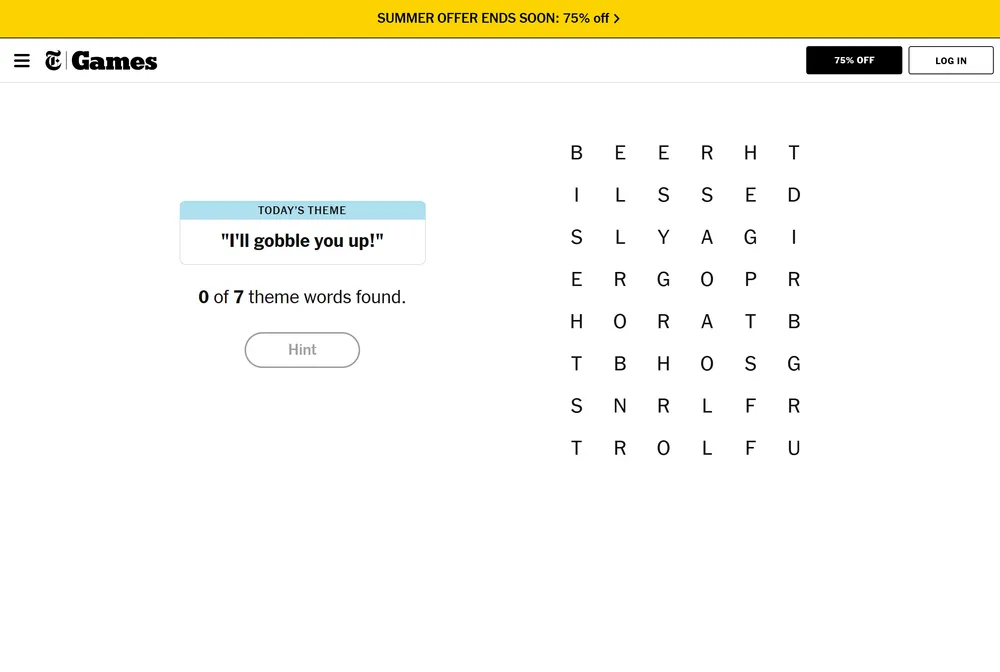
Strands is The New York Times' themed word search, played on a grid of 48 letters where every single tile belongs to exactly one answer. A short clue hints at the day's theme, and your job is to trace all the theme words plus one spangram, a longer answer that reaches across the board and names the theme outright. The challenge is rarely vocabulary alone: the real puzzle is reading the grid backward from a vague clue to figure out what connects everything.
What is Strands?
Strands plays out on a 6 by 8 grid of 48 letters, and the central rule is that there are no spare tiles. Every letter is part of some answer, so the board fills in completely as you solve. You trace words by dragging through adjacent letters in any direction, including diagonals, and each correct theme word locks into place and shrinks the field of remaining letters. Words must be at least four letters long, and the theme clue at the top is your only stated guidance about what those words share.
What sets Strands apart from Wordle and other guess-based games is that there is no penalty for being wrong and no fixed number of attempts. You are not racing a counter; you are excavating a fixed set of answers that already exist on the board. The signature element is the spangram, a single word or short phrase that both describes the theme and stretches from one edge of the grid to the opposite edge. Finding it early is a genuine turning point, because once you know what the theme actually is, the scattered remaining answers tend to snap into focus.
The game was developed inside NYT Games by Juliette Seive, the team's research director, who pitched the concept at the company's annual game jam before a prototype was approved and built out. It is edited by Tracy Bennett, who also edits Wordle, and it entered beta on March 4, 2024 as part of the same daily-puzzle lineup that includes Wordle, Connections, and the Spelling Bee. It runs in a web browser and through the NYT Games app rather than as a standalone product.
When you finish, Strands shows a spoiler-free recap built from small icons: a blue dot for each theme word you found, a yellow dot for the spangram, and a light bulb for any hint you used, all in the order you uncovered them. That grid of dots is what you copy and share, so friends can compare how their solve unfolded without seeing the answers. The difficulty swings widely from gentle Mondays to genuinely tricky themes, which makes it a good fit for players who like lateral thinking and pattern-spotting more than speed, and who enjoy the slow click of a theme finally making sense.
How to play Strands
- Read the theme clue at the top of the board to get a rough sense of what the day's words have in common.
- Drag through touching letters in any direction, including diagonals, to trace a word, then release to submit it.
- When you find a valid word that is not part of the theme, it counts toward earning hints rather than filling the grid.
- Hunt for the spangram, the one answer that runs from one edge of the grid to the opposite edge and names the theme.
- Keep tracing theme words; each correct one locks in and highlights, steadily using up the remaining letters.
- Find three non-theme words to unlock a hint, which highlights the letters of one theme answer to get you unstuck.
Tips and strategy
- Try to pin down the spangram first, since it reaches edge to edge and reveals the theme, which makes every other answer easier to spot.
- Remember that every one of the 48 letters is used exactly once, so as the board fills, the shrinking pool of free letters constrains what the next word can be.
- When the theme clue is cryptic, deliberately farm common non-theme words to bank hints instead of guessing wildly at the grid.
- Scan corners and edges for the spangram, because it has to touch two opposite sides, which limits where its first and last letters can sit.
- Look for letter clusters that suggest a category fitting the clue, then test whether nearby tiles can extend them into a full theme answer.
- Do not fixate on straight lines; Strands words bend and zigzag freely, so a stretch of leftover letters often hides a word that turns several times.
Good to know
- Resets
- Daily, shortly after midnight US Eastern time
- Cost
- Free to play; the official archive needs an NYT Games subscription
- Grid
- 6 by 8 board of 48 letters, minimum word length 4
- Creator
- Juliette Seive (NYT Games), edited by Tracy Bennett
- Publisher
- The New York Times Games
- Launched
- Beta released March 4, 2024
Strands FAQ
Is Strands free?
Yes. The current day's Strands puzzle is free to play at nytimes.com/games/strands with no subscription. Only the archive of past puzzles sits behind a paid NYT Games subscription.
How many guesses do you get in Strands?
There is no guess limit. Wrong attempts are not penalized, so you can submit as many words as you like until you have found every theme word and the spangram.
When does Strands reset?
A new Strands puzzle goes live once a day, shortly after midnight in the US Eastern time zone, so the exact local time it appears depends on where you are.
Is there a Strands archive?
Yes, the New York Times keeps an archive of past Strands puzzles, but access to it requires an NYT Games subscription rather than being free like the daily puzzle.
Is Strands related to Wordle?
Not in gameplay. Strands is a themed word search, not a letter-guessing game, but both are part of the same NYT Games lineup and Strands is edited by Tracy Bennett, who also edits Wordle.