WhereTaken
Guess where a photo was taken on the map.
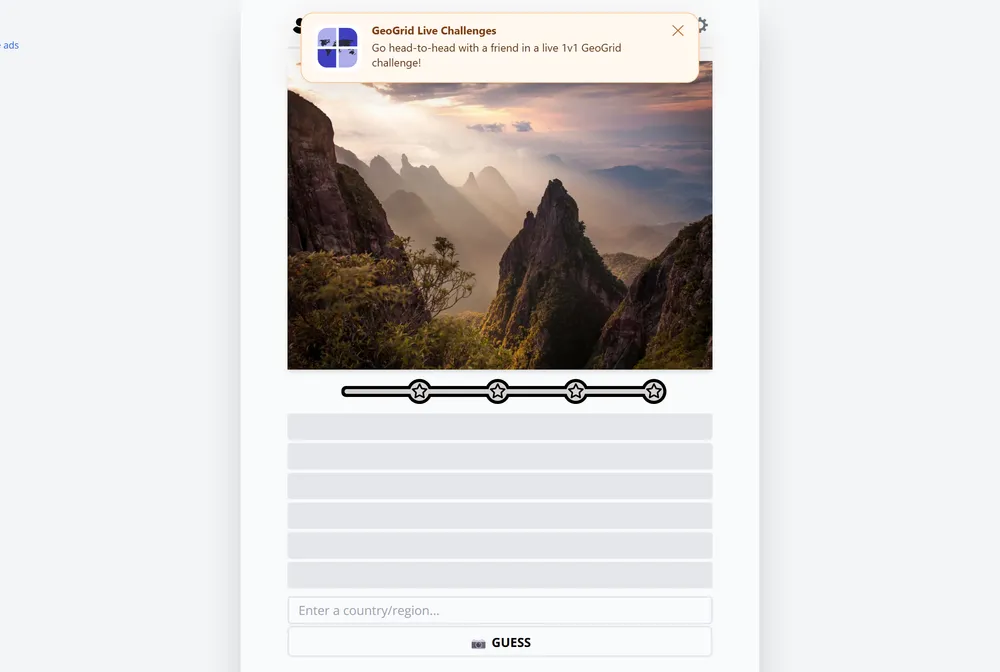
WhereTaken hands you one real photograph each day and asks a deceptively simple question: where on Earth was this picture taken? You answer by naming a country or territory, then read the distance, direction arrow, and proximity percentage to close in on the spot. Everyone plays the same location, so it is built for comparing results.
What is WhereTaken?
WhereTaken is a daily geography game built around a single real photograph. Each day every player sees the same image and is asked one question: where in the world was this taken? You answer by naming a country or territory, and the game responds with three pieces of feedback: the straight-line distance from your guess to the target, an arrow pointing in the direction you need to travel, and a proximity percentage that tells you how warm or cold your guess is, where 100 percent means you are on target. The puzzle is the same location for everyone, which is what makes comparing results with friends meaningful.
What sets WhereTaken apart from the wider family of Wordle-style games is that it leans on a photo rather than a word or a country outline. Instead of letter colors or a map silhouette, your raw material is a scene: the slant of the rooftops, the script on a shop sign, the plants growing by the road, the quality of the light. A wrong guess does not just hand you cold feedback; it reveals an additional photo from the same place, so the location slowly opens up across several images. After you finish the main round, the game unlocks three bonus rounds that test related geography knowledge, giving each daily session a little more to chew on than a single guess.
WhereTaken comes from Teuteuf Games, the studio originally founded by French developer Antoine Teuf, the creator of Worldle, the country-guessing game that took off in 2022. WhereTaken is the photography-focused entry in that lineup, sitting alongside Worldle and the history-themed WhenTaken. The shared design language is easy to spot: distance, direction, and a sense of getting warmer are the studio's signature feedback tools, here applied to real-world pictures rather than map shapes. Because it is part of an established series, the game feels polished and consistent rather than experimental.
In tone WhereTaken is relaxed but genuinely educational. There is no timer pressure built into the core round, so you can sit with a photo and study it like a detective. Difficulty swings widely from day to day: some photos hand you an obvious landmark, while others give you nothing but a stretch of countryside that could be on three different continents. That range is the appeal. It rewards travelers, map nerds, and anyone who likes noticing small cultural details, and the daily one-photo format keeps it a quick habit rather than a time sink. When you finish, you can share your result, which turns the game into a friendly back-and-forth with other players chasing the same location.
How to play WhereTaken
- Open the daily photo and study it closely for clues: architecture, road markings, signage and language, vegetation, climate, and the angle of the light.
- Make your first guess by naming the country or territory you think the photo shows.
- Read the feedback the game returns: the distance to the target, a direction arrow pointing toward it, and a proximity percentage showing how close you are, with 100 percent meaning you are on the spot.
- If you are wrong, note the new photo the game reveals from the same location and fold those extra details into your next guess.
- Adjust using the arrow and distance together, moving from a broad region toward the specific country or territory.
- Lock in the correct location to finish the main round, then play the three bonus rounds that unlock afterward.
Tips and strategy
- Use the direction arrow and distance as a pair: the arrow fixes which way to move, and the distance tells you how far, so one informed second guess can jump across a continent toward the answer.
- Read the script and language on any visible signs before anything else; alphabet and spelling often pin down a region faster than the scenery does.
- Check which side of the road traffic uses and the style of license plates and road signs, since these split large parts of the world into clear groups.
- Let the extra photo from each wrong guess work for you: a second or third image from the same spot frequently reveals a clue the first one hid.
- Identify the climate and vegetation first, then commit to a hemisphere and band of latitude before worrying about the exact country.
- When a photo feels generic, guess a large, centrally located country in your suspected region so the distance and arrow give you the most useful correction.
Good to know
- Resets
- Daily at midnight, local time on your device
- Cost
- Daily game free with ads; archive needs a free account plus paid Premium
- Format
- One shared photo per day, with three bonus rounds after the main round
- Feedback
- Distance, direction arrow, and proximity percentage after each guess
- Archive
- Yes, but past puzzles require a free Teuteuf account plus a paid Premium subscription
- Creator
- Teuteuf Games (founded by Antoine Teuf, creator of Worldle)
WhereTaken FAQ
Is WhereTaken free?
The daily WhereTaken puzzle is free to play in your web browser, supported by ads. Access to the archive of past puzzles is not free: it requires a free Teuteuf Games account plus a paid Premium Membership subscription.
How do guesses work in WhereTaken?
You start with one photo and one guess at the country or territory. Each wrong guess reveals an additional photo from the same location, so you gather more visual clues as you go and refine using the distance, direction, and proximity feedback.
When does WhereTaken reset?
A new photo appears every day at midnight in your device's local time. Everyone playing that day sees the same location.
Is there a WhereTaken archive?
Yes. WhereTaken keeps an archive of earlier daily puzzles, which is handy for practice or for catching up on days you missed. Playing it is not free, though: you need a free Teuteuf Games account and a paid Premium Membership subscription to access past puzzles.
Is WhereTaken related to Wordle?
It is inspired by the daily, one-puzzle-a-day style Wordle made popular, but it is its own game. WhereTaken comes from Teuteuf Games, the studio behind Worldle, and uses real photographs with distance and direction feedback rather than letters or country outlines.