Mathler
Find the equation that hits the target number.
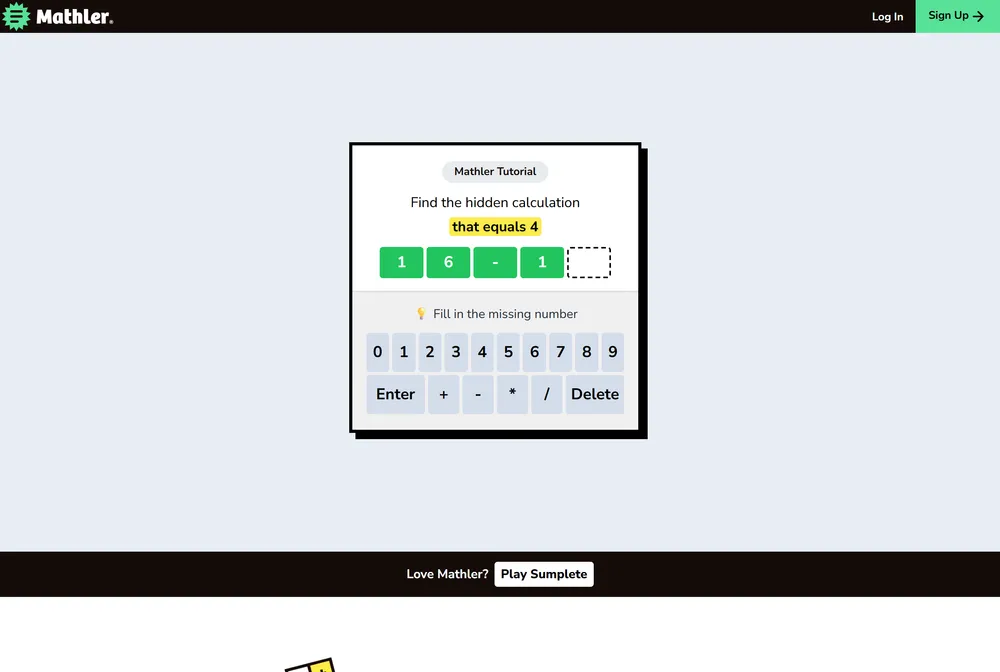
Mathler gives you a target number and challenges you to uncover the hidden calculation that equals it. Instead of guessing a word, you guess a six-character equation built from digits and the four basic math operators, and after each try the board colors every character to show what is right. It is a daily math puzzle that rewards arithmetic sense as much as logical deduction.
What is Mathler?
Mathler is a daily browser puzzle that flips the Wordle formula from letters to arithmetic. Each day you are handed a target number, and your job is to uncover the hidden calculation that produces it. In the standard game that calculation is a six-character equation built from the digits 0 through 9 and the four basic operators for addition, subtraction, multiplication, and division. You commit a full equation on each row, and the board grades every character at once, so the puzzle is less about lucky guessing and more about narrowing the field of equations that can mathematically reach the goal.
What sets Mathler apart from word-based clones is that the answer is constrained by math, not vocabulary. Any guess you submit must actually evaluate to the target, which means you cannot just throw random characters at the grid the way you might test letters in Wordle. The game also respects standard order of operations, so multiplication and division resolve before addition and subtraction. That single rule dramatically widens the set of valid equations and is the source of most of Mathler's depth. Another distinctive touch is its handling of commutative answers: if your equation uses the same numbers in a different order than the intended solution, Mathler accepts it and quietly rearranges your tiles to match, so you are never punished for writing 3+7+20 instead of 20+7+3.
Mathler was created by Daniel Tait, an independent developer who built it in early 2022 amid the wave of Wordle-inspired daily games that sprang up during the broader Wordle craze, around the same time Wordle itself was acquired by the New York Times. Tait is known for several other puzzle projects, including CrossWordle and Sumplete, and he has continued to run and expand Mathler as a solo, free-to-play web game rather than under a large publisher. Over time the site grew from a single daily puzzle into a small family of difficulty levels, so the game now spans gentle warm-ups through tougher challenges using a large bank of equations.
The feedback system is the heart of the experience. After each guess, every tile is colored: green marks a character that is correct and in the right position, yellow marks a character that belongs in the equation but sits in the wrong spot, and gray means the character is not part of the solution at all. Note that digits and operators can repeat within a single equation, which makes reading the yellow and gray clues a careful exercise rather than a simple checklist. When you finish, Mathler generates a spoiler-free emoji grid of your color results that you can copy and share, letting friends compare how efficiently they reasoned their way to the same target. The overall vibe is calm and cerebral: it suits anyone who enjoys mental math, logical elimination, and a short, self-contained daily challenge that rewards arithmetic sense as much as deduction.
How to play Mathler
- Look at the target number displayed above the grid; that number is the value your equation must equal.
- On the first row, type a complete six-character equation in the standard game, using digits 0 through 9 and the operators for plus, minus, times, and divide.
- Make sure your equation genuinely evaluates to the target before submitting, because Mathler only accepts guesses that compute to the goal.
- Submit and read the colors: green means the right character in the right place, yellow means the character is used but in a different spot, and gray means it is not in the solution.
- Use those clues to build your next equation, keeping greens fixed, moving yellows to new positions, and dropping grays entirely.
- Keep refining row by row and solve the hidden calculation within six guesses.
Tips and strategy
- Lean on order of operations: because multiplication and division resolve first, an equation like a number times another plus a third can reach targets that pure addition cannot, so test mixed-operator structures early.
- Treat your opening guess as a probe: spread out distinct digits and at least two different operators so the first round of colors rules out as much as possible.
- Do not waste a guess by reordering the same commutative sum, since Mathler counts a+b and b+a as the same answer and will accept either.
- Watch for repeats: a digit or operator can appear more than once, so a yellow tile may mean a second copy of that character exists elsewhere in the answer.
- Factor the target before guessing; if it has clean divisors, a multiplication-based equation is often shorter to pin down than a long chain of additions.
- Lock in your green tiles and only rearrange the yellows around them, rather than rebuilding the whole equation from scratch each turn.
Good to know
- Resets
- Daily, one new puzzle per difficulty each day
- Cost
- Free to play
- Guesses
- 6 attempts
- Creator
- Daniel Tait, independent developer
- Platform
- Web browser
- Archive
- Yes, past daily puzzles can be replayed
Mathler FAQ
Is Mathler free?
Yes. Mathler is a free browser game with no purchase required and no paywall blocking the daily puzzles.
How many guesses do you get in Mathler?
You get six guesses to find the hidden equation. Each guess must be a full equation that evaluates to the day's target number.
When does Mathler reset?
A new puzzle is released once per day for each difficulty level, with the rollover tied to a daily reset, so there is a fresh target number to solve every day.
Is there a Mathler archive?
Yes. Mathler offers an archive where you can go back and play past daily puzzles, which is useful for catching up on days you missed or replaying favorites.
Is Mathler related to Wordle?
Mathler is inspired by Wordle but is not affiliated with it. It keeps the six-guess grid and green, yellow, and gray color feedback, but you solve a math equation toward a target number instead of guessing a word.
Are there different difficulty levels in Mathler?
Yes. Beyond the standard six-character game, Mathler offers easier puzzles with fewer tiles for a gentler warm-up, plus a harder eight-tile mode that adds parentheses and an extreme mode that removes the yellow hints for an extra challenge.