Nerdle
Wordle for math: crack the daily equation.
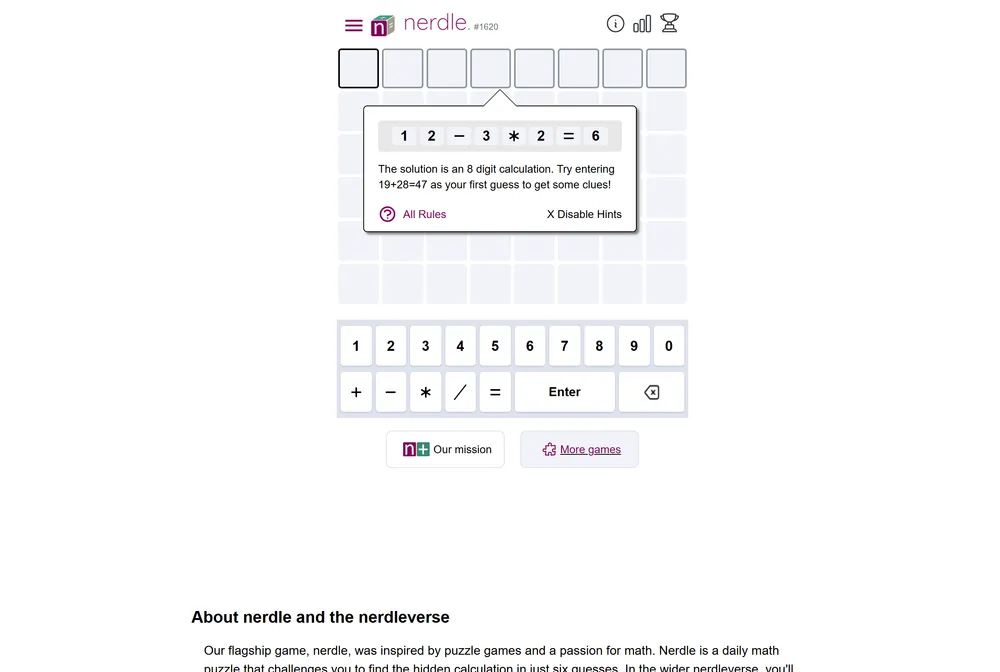
Nerdle swaps Wordle's hidden word for a hidden equation: a row of eight tiles that has to balance around an equals sign. You get six guesses, and after each one the tiles tell you which digits and symbols are correct and which are out of place. It is a short daily numbers puzzle that rewards arithmetic over vocabulary.
What is Nerdle?
The core of Nerdle is one calculation hidden behind eight tiles, refreshed once per day so every player worldwide works on the same equation. Classic Nerdle fills those eight slots with digits (0 through 9), the operators plus, minus, multiply and divide, and exactly one equals sign, and the whole line has to be true. A guess like 12+34=46 is a complete, valid statement, and that requirement is the heart of the game: you cannot toss in a half-finished row of random characters, because every guess must itself be a real, balanced equation.
What sets Nerdle apart from the wider field of Wordle-style games is that logic, not language, drives the solve. The answer obeys standard order of operations (PEMDAS/BODMAS), the right side of the equals sign is a single number, and the search space is constrained by arithmetic truth rather than a dictionary. By default Nerdle also treats commutative answers as equivalent, so if the hidden line is 1+2=3 then entering 2+1=3 counts as the same solution; that behavior can be toggled off in settings for players who want a stricter target.
Nerdle launched in January 2022, created by Richard Mann together with his daughter Imogen, who helped shape the game's concept and rules. His son Alex Mann is credited with working out the valid calculations behind the puzzle, and Marcus Tettmar built the game itself. It arrived during the post-Wordle wave of daily puzzles and grew into a small family of math games, sometimes called the nerdleverse, that now includes shorter and timed formats alongside the original. The classic eight-tile puzzle remains the flagship.
Feedback uses three tile colors: green means a digit or symbol is correct and in the right position, purple means it appears in the equation but sits somewhere else, and black means it is not used at all. When you finish, a win screen lets you share a spoiler-free grid of colored squares to apps or your clipboard, the same quick brag-and-compare loop Wordle players know. Beyond the daily Classic puzzle, Nerdle offers Mini (six tiles), Speed, Instant, and Pro variants, plus a replay feature that lets you load any past date back to launch. The vibe is calm and quick rather than cutthroat: comfortable for anyone confident with basic arithmetic, and a genuine daily workout for people who simply enjoy numbers.
How to play Nerdle
- Open the daily Classic Nerdle puzzle, which gives you eight tiles to fill and six total guesses.
- For your first guess, type a complete and valid equation that uses the equals sign and actually balances, for example 12+34=46.
- Submit the row; if it is not a true calculation, Nerdle rejects it with a 'doesn't compute' message and the guess does not count.
- Read the colors: green tiles are correct and correctly placed, purple tiles belong in the equation but in a different spot, and black tiles are not in the answer at all.
- Build your next guess using those clues, keeping every confirmed green tile in place and moving purple digits or operators to new positions.
- Repeat until you reveal the hidden equation, aiming to lock it in within six guesses, then share your result grid if you like.
Tips and strategy
- Open with a guess that packs in many different digits plus a couple of operators, so a single row tests a wide set of characters at once.
- Remember the equals sign is one of the eight tiles, so use its position feedback: once a green pins where the equals goes, the size of the result on the right is fixed.
- Treat the math, not just the colors, as a constraint: because every guess must balance, you can rule out candidates by checking whether they could ever produce a true equation.
- Lean on division and multiplication early, since a purple or green operator quickly narrows whether the answer involves large products or small quotients.
- Use the result number's length as a clue: a single-digit answer on the right means very different left-side combinations than a two-digit answer.
- If commutative answers are enabled, do not waste a guess just reordering the same numbers and operators, since Nerdle treats that as the same solution.
Good to know
- Resets
- Daily at midnight GMT (a local-midnight option is available in settings)
- Cost
- Free, no paywall
- Guesses
- 6 attempts
- Tiles
- 8 in Classic mode (6 in Mini)
- Archive
- Replay any past daily puzzle back to the January 2022 launch
- Creator
- Richard Mann and family, launched January 2022
Nerdle FAQ
Is Nerdle free?
Yes. The daily Nerdle puzzle and its variants are free to play with no subscription or paywall.
How many guesses do you get in Nerdle?
You get six guesses, and each one has to be a complete, valid equation or it is rejected and does not count against you.
When does Nerdle reset?
A new puzzle drops every day at midnight GMT, so players worldwide share the same equation. You can switch it to reset at your local midnight in settings.
Is there a Nerdle archive?
Yes. Nerdle's replay feature lets you load and solve past daily puzzles going back to the game's January 2022 launch, which is useful if you miss a day.
Is Nerdle related to Wordle?
Nerdle is inspired by Wordle's six-guess, color-coded format, but it is a separate game with its own creator. Instead of a hidden word you crack a hidden math equation across eight tiles.